
TEHRAN: Eighteen people were killed in a fire at an ammunitions store in a Revolutionary Guards base in Iran, the Fars news agency quoted a commander of the elite force as saying Wednesday in the latest toll. "In yesterday's explosion at one of the Guards' bases in Lorestan (in western Iran), 18 people were killed and 14 wounded," commander Yadollah Bouali said. He said some of the casualties in Tuesday's blast were workers at the base but did not specify whether they included members of Guards. On Tuesday, Bouali said the explosion hit when fire spread to the munitions store at the base near the provincial capital Khorramabad.

The provocative comments prompted the US delegation to walk out of Ahmadinejad's UN speech, where he also blamed the US as the power behind UN Security Council sanctions against Iran for its refusal to halt uranium enrichment, a technology that can be used as fuel for electricity generation or to build nuclear weapons.
Delegations from all 27 European Union nations followed the Americans out along with representatives from Australia, New Zealand, Canada and Costa Rica, an EU diplomat said.
Ahmadinejad said the US has allocated $80 billion to upgrade its nuclear arsenal and is not a fair judge to sit as a veto-wielding permanent member of the Security Council to punish Iran for its nuclear activities. Iran denies it is seeking a nuclear weapon.
The Iranian leader _ who has in the past cast doubt over the US version of the Sept. 11, 2001, attacks _ also called for setting up an independent fact-finding UN team to probe the attacks. That, he said, would keep the terror assault from turning into what he has called a sacred issue like the Holocaust where ''expressing opinion about it won't be banned''.
Ahmadinejad did not explain the logic behind blaming the US for the terror attacks but said there were three theories:
_That a ''powerful and complex terrorist group'' penetrated US intelligence and defenses, which is advocated ''by American statesmen.''
_''That some segments within the US government orchestrated the attack to reverse the declining American economy and its grips on the Middle East in order also to save the Zionist regime. The majority of the American people as well as other nations and politicians agree with this view.''
After Ahmadinejad uttered those words, two American diplomats stood and walked out without listening to the third theory: That the attack was the work of ''a terrorist group but the American government supported and took advantage of the situation.''
Mark Kornblau, spokesman of the US Mission to the world body, issued a statement within moments of the walkout.
''Rather than representing the aspirations and goodwill of the Iranian people,'' he said, ''Mr. Ahmadinejad has yet again chosen to spout vile conspiracy theories and anti-Semitic slurs that are as abhorrent and delusional as they are predictable.''
Ahmadinejad said the US used the Sept. 11 attacks as a pretext to invade Afghanistan and Iraq, killing hundreds of thousands of people. He argued that the US, instead, should have ''designed a logical plan'' to punish the perpetrators and not occupy two independent states and shed so much blood.
He boasted of the capture in February of Abdulmalik Rigi, the leader of an armed Sunni group whose insurgency in the southeast of Iran has destabilized the border region with Pakistan. He praised Iranian security forces for capturing him in an overseas operation without resorting to violence. Rigi was later hanged.
Ahmadinejad's attacks on the United States and the dispute over Iran's nuclear program dominated the opening of the General Assembly's annual ministerial meeting.
Secretary-General Ban Ki-moon warned kings, prime ministers and presidents in his keynote address of the growing political polarization and social inequalities in the world and implored UN members to show greater tolerance and mutual respect to bring nations and peoples together.
''We hear the language of hate, false divisions between 'them' and 'us,' those who insist on 'their way' or 'no way,''' he said.
In times of such polarization and uncertainty, Ban said, ''let us remember, the world still looks to the United Nations for moral and political leadership.''
President Barack Obama, speaking soon after, echoed the secretary-general, warning that underneath challenges to security and prosperity ''lie deeper fears: that ancient hatreds and religious divides are once again ascendant; that a world which has grown more interconnected has somehow slipped beyond our control.''
The US president's 32-minute speech _ more than twice the allotted 15 minutes _ covered global hotspots from Iran and Afghanistan to the Mideast and North Korea.
Obama said Iran is the only party to the Nuclear Nonproliferation Treaty ''that cannot demonstrate the peaceful intentions of its nuclear program'' and as a result the UN Security Council has imposed four rounds of increasingly tough sanctions.
''The United States and the international community seek a resolution to our differences with Iran, and the door remains open to diplomacy should Iran choose to walk through it,'' he said. ''But the Iranian government must demonstrate a clear and credible commitment, and confirm to the world the peaceful intent of its nuclear program.''

Dozens of people were wounded in the blast, which occurred during an annual military parade in the northwestern Kurdish town of Mahabad, Arabic-language television channel Al-Alam said.
“The explosion happened in the morning as people were watching the military parade and it left nine dead and dozens wounded, mostly women and children. The explosives were in a bag,” Al-Alam said.
Provincial governor Vahid Jalalzadeh confirmed the casualties to the official IRNA news agency.
“Counter-revolutionaries committed this savage act with the aim of taking revenge on the people of Mahabad” in West Azarbaijan province, he said.
The attack took place as Iran marked the 30th anniversary of the start of the eight-year Iran-Iraq war, during which army parades are traditionally staged across the country.
Western Iran, which has a sizeable Kurdish population, has seen deadly clashes in recent years between the Iranian security forces and Kurdish militant groups, mainly the Party of Free Life of Kurdistan (PJAK) operating from bases in neighbouring Iraq.
In Tehran earlier in the day, Iran's top military commander insisted that the Islamic republic's military power was for defensive purposes only.
“The increased military capability of Iran is only a deterrent against aggressors and for defending our country against enemy threats,” chief of staff Major General Hassan Firouzabadi said in a speech.
“We can confidently tell people that our military might is superior in the region but our military superiority is not limited to the number of planes and material calculations,” he boasted.
Firouzabadi, flanked by Iran's top military commanders, made the speech at a military parade where Iran's long-range Sejil, Shahab-3 and Ghadr-1 missiles were also showcased.
With a range of 1,800 to 2,000 kilometres, the missiles are theoretically capable of hitting Iran's archfoe Israel.
Iraq's Saddam Hussein attacked Iran on September 22, 1980, shortly after the Islamic revolution, starting an eight-year war during which an estimated one million people were killed on both sides.
During the Tehran parade, Iran also showed off five of its “bomber” drones Karar (“Assailant”), first unveiled in August and said to have a range of 1,000 kilometres. Iran touted the aerial drone as its home-grown capacity to resist attack.
Iran also paraded for the first time Wednesday a “Blue Beret” unit of 180 men as well as several armoured personnel-carriers emblazoned with UN insignia.
Iran's army chief Ataollah Salehi said that Iran “has been ready for several years to provide a group of peacekeeping soldiers to the United Nations”.
Iranian peacekeepers have already been “involved in several places such as Somalia and Eritrea,” he told reporters, without elaborating.
The United States and Israel accuse Iran of seeking nuclear weapons and have never ruled out a military strike to thwart its atomic programme, which Tehran insists is solely aimed at peaceful purposes.
Iranian officials have vowed a crushing response in the event of an attack, targeting US bases in the region and Israel, and threatening to block the oil passage in the Gulf.
Iranian President Mahmoud Ahmadinejad during a New York meeting with US media on Tuesday warned that an attack on his country's nuclear facilities could spark a war with “no limits”.
As Iran presses on with its nuclear programme and stages regular war games showing off missiles and domestically-developed weaponry, it has also sought to allay concerns of its Arab neighbours across the Gulf that it poses no threat to them.
Saudi Arabia, however, is planning a 60-billion-dollar arms deal of advanced warplanes and helicopters with the United States, according to US defence officials this week.
Analysts say the purchase — which would represent the largest ever US arms deal — is to help counter the perceived threat from Iran.
The United States voiced concern, saying Iran's arms build-up would backfire as its neighbours gang up against it.
Iranian border guards detained seven U.S. troops as they tried to illegally enter the Islamic state, a local news agency reported on Sunday, without giving a source. "Recently seven American troops were detained by Iranian guards in a southeastern province of the country ... Two Iranians accompanying the troops were also arrested," said the news agency. No other news agency reported the incident.

“After the decision of the Tehran revolutionary tribunal, Abdolmalek Rigi was hanged on Sunday morning in Evin prison,” IRNA said.
It quoted a court statement as saying: “The head of the armed counter-revolutionary group in the east of the country ... was responsible for armed robbery, assassination attempts, armed attacks on the army and police and on ordinary people, and murder.” Rigi was captured in February while on a flight. He led a shadowy Sunni militant group called Jundallah (Soldiers of God) that had waged a deadly insurgency in southeastern Iran killing civilians as well as military officials.
Iran says the group was backed by the United States.
IRNA, quoting the court statement, said Rigi's group was “responsible for the killing of 154 members of security forces and other innocent people and wounding of 320 people since 2003.” It said Jundallah was “linked to members of foreign intelligence services, including members from US and Zionist regime's intelligence services under the cover of NATO.” It was also linked to intelligence services of some Arabic countries and counter-revolutionary group People's Mujahedeen, the statement said.
Rigi himself was charged with forming the “terrorist group Jundallah which was fighting the Islamic republic.” He collaborated and ordered 15 armed abductions, confessed to three murders, ordered the murders of tens of citizens, police and military personnel through bombings and armed actions,” the statement added.
IRNA said he had been sentenced to be hanged in front of the relatives of some of the victims of his attacks, but the report did not specify whether he was actually executed in their presence.

“Pakistan has an obvious, major energy problem and we are sympathetic to that, but in regards to a specific project, legislation is being prepared that may apply to the project,” he said, referring to the pipeline.
“We caution the Pakistanis not to over-commit themselves until we know the legislation.”
Pakistan is plagued by chronic electricity shortages that have led to mass demonstrations.
US Senator Joseph Lieberman said last week he expects Congress to finish shortly legislation tightening US sanctions on Iran that will include provisions affecting the supply of refined petroleum products to Tehran, and add to sanctions on its financial sector.
Lieberman, an independent, is a member of a House-Senate committee of negotiators working on final details of the bill and said it could pass by July 4.
The $7.6 billion natural gas pipeline deal, signed in March, doesn't directly deal with refined petroleum products and was hailed in both Iran and Pakistan as highly beneficial.
The US has so far been muted in its criticism of the deal, balancing its need to support Pakistan, a vital but unstable ally in the global war against al-Qaeda, with its desire to isolate Iran.
But the legislation could be comprehensive enough to have major implications for Pakistani companies, Holbrooke said.
“We caution Pakistan to wait and see what the legislation is.”
This was Holbrooke's tenth trip to Pakistan since President Barack Obama appointed him special representative to the region. His visit followed a series of working groups this week that are part of the US-Pakistan strategic dialogue, which both countries say will lay the groundwork for a new relationship.
Afghanistan was on the agenda in meetings with the Pakistani leadership, Holbrooke said, including talks on a Pakistani role in talks between the Afghan Taliban and the Kabul government.
But the United States would not support Pakistan pushing the Haqqani network, one of the strongest factions of the Afghan insurgency and mostly based in Pakistan's North Waziristan, into talks with Kabul as Washington sees the group as intransigent, brutal and too tightly allied with al-Qaeda.
The United States has said any groups wishing to lay down their weapons must renounce al-Qaeda and agree to participate peacefully in the Afghan political process.
“It's just hard to see that happening,” Holbrooke said of the Haqqani network.
Regardless of what happens in Afghanistan, he said, the United States would remain engaged with Pakistan.
“Pakistan matters in and of itself. Whatever happens in Afghanistan, the US cannot turn away from Pakistan again,” he said. “We are not going to repeat the mistakes that occurred — at least not on our watch — of the last 20 years.”


The Security Council is to vote on a fourth round of sanctions to tighten financial curbs on Iran, while expanding a limited arms embargo.
US Secretary of State Hillary Clinton said they were "the most significant sanctions that Iran has ever faced".
But Iran's president warned his country would not agree to nuclear talks if the sanctions were imposed.
Mahmoud Ahmadinejad also said that a nuclear fuel-swap deal brokered by Turkey and Brazil was an offer that would not be repeated.
Iran agreed in May to deposit 1,200kg of low-enriched uranium with Turkey, in return for reactor fuel, but the US and its Western allies said the agreement was too little too late.
They fear Tehran is secretly trying to build a nuclear bomb. Iran says its programme is aimed solely at peaceful energy use. Kill negotiations?
There have been three rounds of UN sanctions against Iran, blocking trade of "sensitive nuclear material", freezing the financial assets of those involved in Iran's nuclear activities, banning all of Iran's arms exports and encouraging scrutiny of the dealings of Iranian banks.
Although it was watered down during negotiations with Russia and China on Tuesday, it does tighten existing restrictions on areas like shipping and finance.
Its proposals include:
Prohibiting Iran from buying several categories of heavy weapons including attack helicopters and missiles
Urging all states to inspect cargo suspected of containing banned items to and from Iran in their territory, including seaports and airports
Calling on countries to block financial transactions and ban the licensing of Iranian banks if they suspect a link to nuclear activities
Increasing the number of individuals - reportedly including senior nuclear officials - and companies targeted with asset freezes and travel bans
Mrs Clinton was upbeat about the prospect of of the new resolution, which has the support of all five of the UN's veto-holding members.
Brazil and Turkey - also security council members - say the sanctions will kill attempts to revive negotiations with Iran, and put that case forward in a last-minute special session at the UN on Tuesday.
Despite their reservations, though, the BBC's Barbara Plett at the UN headquarters in New York said there was little doubt the resolution will be adopted.
While Turkey, Brazil and Lebanon are not expected to back the resolution, none of them has a veto.
Western diplomats expect 12 countries on the 15-member council to vote for the measure. Backing Iran's enemies?
Mr Ahmadinejad, speaking on Tuesday in Istanbul where he is attending a regional summit, said that if the US did not change its position "the first ones to lose would be President Obama and the people of the United States".
His comments came ahead of talks with Russian Prime Minister Vladimir Putin, who is also attending the summit in Turkey, and has in the past cautioned against tough action on Iran.
Amid heightened tensions over the new resolution, Iran said on Tuesday it had evidence one of its nuclear scientists was abducted and was being held in the US against his will.
Shahram Amiri disappeared a year ago while on a pilgrimage to Saudi Arabia.
A video broadcast by Iranian TV on Tuesday purported to show Mr Amiri saying he had been kidnapped and was living in Arizona.
Hours later, another video posted on YouTube appeared to show the scientist saying he was happy in America. The US has denied abducting him.
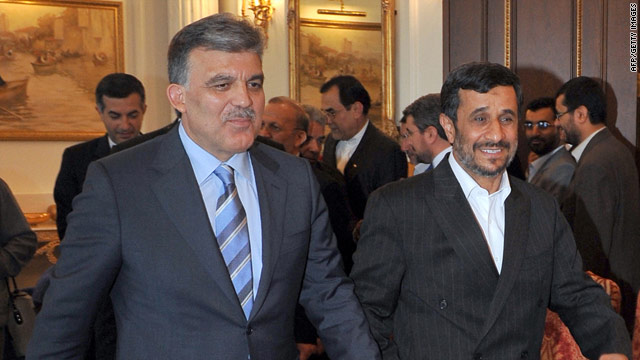
A key item on the agenda at the summit is last week's Israeli raid on an aid flotilla in the Mediterranean. Ahmadinejad said the confrontation revealed Israel's "devilish" nature.
"It showed violence and hatred and war-mongering attitudes," he said at a news conference. "The devilish sound of the uncultured Zionists was coming out from their deceit. ... They were holding up the flag of the devil itself."
The raid led to the deaths of nine people, all Turkish citizens -- including one Turkish-American. Turkey is urging Israel to accept an international probe into the incident.
Ahmadinejad congratulated Turkey, which has been in a war of words with Israel following the raid, for its response.
Iran's own nuclear program has been another major topic at the summit. The United States expects to bring a new resolution on increased sanctions against Iran over its nuclear program to a vote in the United Nations Security Council this week.
By calling for a resolution instead of sitting down for talks with Iran, the United States is "gravely mistaken," Ahmadinejad said.
"Within the framework of respect and justice, we're ready to negotiate with everyone. Anyone who is going to resort to the language of force and aggression, the response is clear," he said.
Ahmadinejad went on to commend Turkey and Brazil for recently negotiating a deal with Iran on a uranium enrichment swap.
"The initiative marked the beginning of a new path -- the beginning of an end to unilateralism in the world," he said.
The United States, he added, missed an opportunity by not embracing the deal.
Asked whether the raid on the flotilla last week will change the way countries vote in the Security Council, Ahmadinejad said the raid will actually change many things.
For Israel, he said, "it has actually rung the final countdown for its existence. It shows that it has no room in the region and no one is ready to live alongside it. Actually, no country in the world recognizes it, and you know that the Zionist regime is the backbone of the dictatorial world order."
He added, "Maybe at the Security Council, it will impact temporarily. The Zionist regime, with what it has done, it actually stopped its possibility to exist in the region anymore."
ISTANBUL: Iran will not agree to talks on its nuclear programme if the UN Security Council adopts fresh sanctions, President Mahmoud Ahmadinejad said Tuesday. "I have said that the US government and its allies are so mistaken that if they think they can brandish the stick of resolution and then sit down to talk with us, such a thing will not happen," the Iranian leader told a news conference here. "We will talk to everyone if there is respect and fairness but if someone wants to talk to us rudely and in a domineering manner the response is known already," he added. His warning came as the UN Security Council prepared to hold new closed-door consultations Tuesday on a fourth sanctions resolution against the Islamic Republic after its 15 members failed to reach a consensus on a meeting on Monday. The council's five council permanent members -- Britain, France, China, Russia and the United States -- are co-sponsoring the sanctions draft and are aiming to hold a vote later this week. Ahmadinejad, who is in Turkey for the summit of an Asian security grouping, urged Western powers not to dismiss a nuclear fuel swap deal brokered by Turkey and Brazil last month. The deal "was an opportunity for the US government and its allies...I hope they will put this to good use. Opportunities will not be repeated," he said. The United States and other world powers have given a cool reaction to the deal under which Iran agreed to ship 1,200 kilograms (2,640 pounds) of its low-enriched uranium to Turkey in return for high-enriched uranium fuel for a Tehran reactor.
About Me


