

The U-23 football event kicked off five days prior to the actual opening of the games. The Group ‘F’ encounter between Pakistan and Thailand saw the latter on constant attack from the word go (Pakistan got one shot at the goal while Thailand 16) while a few good initial saves on Pakistan’s goalkeeper and captain Jafar Khan’s part proved to be futile in the end.
Pakistan were 0-3 at interval with Thailand’s captain Datsakorn Thonglao leading from the front to get them their first and third goals in the 15th and 29th minutes with Teerasil Dangda scoring in 16th minute in between.
The thrashing of the green jerseys continued in the second half, too, with three more coming from the Thai boys sporting royal blue kits in the 59th (Kirati Keawsombut), 65th (Anawin Jujeen) and 73rd (Teerasil Danga again) minutes.
Although they scored no goals, Pakistan did, however, earn three yellow cards when Haider Ali, Mohammad Ahmed and Aurangzeb Baloch were cautioned by referee Sabbagh Ali.
AFP adds: In the other matches of the day, Qatar opened their account with a 0-0 draw against Singapore while the United Arab Emirates were held to a 1-1 draw by Hong Kong.
But Kuwait, Oman and Uzbekistan got their tournament off to winning starts with comfortable opening victories.
Kuwait, recently crowned champions of the West Asian football tournament in Jordan, proved too good for India in Group ‘D’, winning 2-0 with an early strike from Mohammad Alrashedi setting them on their way.
Alazemi Khaled ensured the three points with a fine finish in the 53rd minute. Uzbekistan cruised past Bangladesh 3-0 in Group ‘E’, with first-half goals from Kenja Turaev and Odil Ahmedov putting them firmly in charge before Ivan Nagaev added a late third. In another Group F clash, Oman beat the Maldives 3-0.
BEIJING: China’s main nuclear energy corporation is in talks to build a 1GW atomic power plant in Pakistan, a China National Nuclear Corporation (CNNC) executive said on Monday.China has already helped Pakistan build its main nuclear power facility at Chashma in Punjab, where one reactor is running and another nearly finished, and it has contracts to build two more there, despite the qualms of other governments. Qiu Jiangang, vice president of the CNNC, told a meeting in Beijing that the company was already looking beyond those deals to an even bigger plant.“Both sides are in discussions over CNNC exporting a 1GW nuclear plant to Pakistan,” he said. Qiu confirmed the two countries had signed contracts to build the No 3 and No 4 reactors of about 300MW each at Chashma. He did not give details about who was involved in discussions for the bigger plant and how far the talks had progressed.A senior Pakistani government official familiar with discussions between Pakistan and China on nuclear cooperation said, “We are facing acute energy shortages and these nuclear power plants are important for us to overcome these shortages.” “We as well as China have said time and again that all this cooperation is under the safeguards of the International Atomic Energy Agency and there should not be any worries or concerns about it,” said the official, who demanded anonymity.
HONG KONG: The Hong Kong government’s plan to introduce limited political reforms appeared on Tuesday almost certain to be approved after it won the support of a group of pro-democracy lawmakers. The Democratic Party, which holds the swing vote on the issue and is the city’s largest opposition party, agreed to endorse the reform package, which will raise the number of directly elected officials in the city’s legislature. The former British colony, which was returned to China in 1997, has a legal and administrative system independent of mainland China’s but its constitutional development falls under Beijing’s control. Only half of the current 60-seat legislature is directly elected, with the remainder picked by “functional constituencies” based on professions and mainly comprising pro-Beijing elites. Under an original reform plan, the government proposed expanding the number of seats in the legislature to 70, with the new seats equally divided between directly elected and functional constituency seats. However, the Democratic Party had rejected that and proposed the five new functional constituency seats also be directly elected, and it is this package that will be put to the vote on Wednesday. On Tuesday, the Democratic Party’s chairman, Albert Ho, said the majority of its members had now agreed that their nine lawmakers should support the revised plan. “We understand there will be different opinions on our decision. We will shoulder the responsibility for our decision,” Ho told reporters. The party and some critics consider the latest development a breakthrough, opening for the first time a channel of communication between Beijing and the city’s democrats, many of whom are banned from travelling to mainland China. However, the latest blueprint has deeply divided the pro-democracy camp, with the hardliners vowing to block it. Martin Lee, the city’s democracy figurehead, has warned he may quit the Democratic Party, which he helped found, in protest at the compromise. Andrew Cheng, one of the party’s lawmakers, said he would vote against the proposal and would also consider quitting the party. The League of Social Democrats, a more radical pro-democracy faction, accused the Democratic Party of betraying Hong Kong’s democratic progress for political interests and said they would end their cooperation with the group. “They have betrayed democracy by striking under-table deals with Beijing,” maverick lawmaker “Long Hair” Leung Kwok-hung told AFP. Opposition groups have called on the government to postpone the vote to give the public more time to consider the revised plan. But the government refused to budge. “The reform plan has already undergone a thorough consultation. The government has decided to have the vote conducted as scheduled,” said Stephen Lam, Secretary for Constitutional and Mainland Affairs. Critics argue that the latest plan does nothing to clarify how and when Hong Kong will achieve universal suffrage, a process dictated largely by Beijing. Beijing has said that, at the earliest, universal suffrage can be ushered in for the election of Hong Kong’s chief executive in 2017 and for the legislative assembly in 2020. The city’s leader is chosen by an electoral body whose members are handpicked by Beijing.


“I want to stress that the civilian nuclear cooperation between China and Pakistan is in line with each side's international obligations,” Chinese Foreign Ministry spokesman Qin Gang told a news briefing in Beijing.
“It is for peaceful purposes, and is under the supervision of the International Atomic Energy Agency,” he added without elaborating.
US State Department spokesman P.J. Crowley told reporters on Tuesday that Washington had asked China for more details on the deal.
“We have asked China to clarify the details of its sale of additional nuclear reactors to Pakistan. This appears to extend beyond cooperation that was grandfathered when China was approved for membership in the Nuclear Suppliers Group,” he said.
“We believe that such cooperation would require a specific exemption approved by consensus of the Nuclear Suppliers Group,” Crowley said.
The United States was expected to oppose the China-Pakistan deal next week at a meeting of the Nuclear Suppliers Group.
The 46-nation group controls trade in “dual-use” nuclear fuel, materials and technology to ensure they are applied only to civilian nuclear energy programmes and not diverted into clandestine nuclear weapons work.
The Washington Post reported that China had suggested that the sale was grandfathered from before it joined the NSG in 2004, because it was completing work on two earlier reactors for Pakistan at the time.

Vietnam Airlines officially became a full member of SkyTeam, the world's second largest airline alliance, in Ha Noi Thursday, making it the only carrier in Southeast Asia to be admitted as a member.
"This event marks a significant milestone for the national flag carrier and it is vivid evidence of the continued international integration of Vietnamese enterprises. It also represents a great contribution to the achievements of the country during the doi moi (renewal) process," said Prime Minister Nguyen Tan Dung.
"Membership of the alliance not only brings huge benefits to Vietnam Airlines but also helps raise the prestige and position of SkyTeam and its members," he added.
The Prime Minister expressed his hope that Vietnam Airlines would continue developing and further promote the image of Viet Nam as a peace-loving, active, friendly and unique country abroad.
He also said he hoped SkyTeam would continue to develop and expand, attract more customers and reap greater success.
CEO of Vietnam Airlines Pham Ngoc Minh said the close co-operation among SkyTeam member airlines throughout the air transportation chain would facilitate the expansion of its flight network, the sharing of experiences, and the application of advanced technologies.
"In addition, resource-sharing will help member airlines save costs, and improve service quality, which will in turn bring more benefits to customers and greater business efficiency to each member airline, including Vietnam Airlines," Minh said.
Vietnam Airlines intended to become the second largest airline in the Asean bloc, Minh said.
Leo Van Wijk, chairman of SkyTeam Governing Board, also pointed out other benefits: "Vietnam Airlines customers can also earn and redeem frequent flyer mileage when travelling on flights of all other SkyTeam member airlines. And customers from other SkyTeam frequent flyer programmes can achieve the same when flying Vietnam Airlines."
"Asia is a strategic growth market for SkyTeam and we are well on track to strengthen our network in this part of the world. Therefore, we are proud to welcome the first carrier from Southeast Asia," Leo said.
"Vietnam Airlines will firmly contribute to this objective, by adding 20 unique destinations to the SkyTeam network," he added.
With Vietnam Airlines as its 10th member, the SkyTeam Global Airline Alliance has made its official entrance in Southeast Asia, one of the most dynamic regions with rapid economic growth with Viet Nam now acting as the gateway for the alliance to access a market of 200 million people in Cambodia, Laos, Myanmar and Viet Nam.
The other nine members of the alliance include Aeroflot, Aeromexico, Air France, Alitalia, China Southern, Czech Airlines, Delta Air Lines, KLM Royal Dutch Airlines and Korean Air, and two associate members: Air Europa, and Kenya Airways with its flight network to 856 destinations in 169 countries.
Vietnam Airlines expects to transport 12 million local and foreign passengers this year with 290 flights per day, for revenues of VND32.2 trillion (US$1.69 billion) and profits of VND151 billion ($7.9 million) this year.
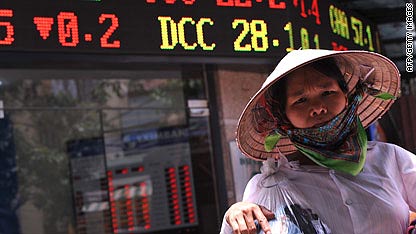
This is what 10 years of an average annual growth of 7 percent looks like: The streets are even more clogged with motorbikes but now compete with a stream of Toyotas, Kias and Fords. The city center is clean - the dust in the air now is from building sites rather than badly-paved roads. (From my hotel room looking across the bustling Saigon River I can see perhaps 20 cranes perched on top of semi-completed high-rises.)
The brand name stores are starting to appear although still – some would say thankfully –no sign of McDonald’s.
To say Vietnam is open for business is an understatement – and this Southeast Asian growing powerhouse is deadly serious about drawing foreign business.
The World Economic Forum’s East Asia meeting chose Ho Chi Minh City (or Saigon, if you prefer) for its first event in a true emerging market. Organizers were expecting about 250 to 300 business people this week, but more than 400 came from across the world.
The government is out in force too. Prime Minister Nguyen Tan Dung is everywhere, chatting up the opportunities. He wants Vietnam to be Asia’s manufacturing base of choice after China.
It’s a tall order, and at the moment Vietnam is seen as a production base for lower value-added goods like textiles, furniture or footwear.
But times are changing. Samsung and Canon are both investing heavily in electronics manufacturing and service bases. Most of the big Asian carmakers as well as Ford are producing for the local market with an eye on exports later down the line.
I met Tom Schneider, a German businessman who has just outlaid $12 million to build a tanning factory at an industrial park on the outskirts of Ho Chi Minh City.
Forthright and ebullient, Schneider’s built eight factories in Asia in the past 16 years. In Vietnam it took him just 22 months, from finding the land, building the factory, and training the workforce – his fastest project anywhere.
He now produces 80,000 hides a month, enough for about 1.5 million pairs of shoes. Timberland is his biggest customer.
And he’s quick to point out that although tanning is “environmentally hostile” his new plant is greener than his existing plant in China, which has received a silver medal standard for environmental protection from Timberland.
So why move to Vietnam? It’s cheaper. Labor costs are about 60 percent of China’s although senior management is still more expensive. The country is close to many of his key customers, and there’s little state intervention, as long he observes workplace and environmental standards.
And in the long run, Vietnam has key access to a vast and cheap labor pool across the borders of Cambodia and Laos.
It’s not all upside. Transport links are still – as Tom describes – at the same level as China in 1988. And the law is still open to interpretation (nearly all big foreign investors insist in any contract on having litigation settled in an offshore court).
Foreign investment is coming. In 2008 about $70 billion was committed to Vietnam, up more than threefold from five years year. It’s fallen back to $20 billion last year. Not surprising, though, given the global economic picture.
I asked the Prime Minister how he would describe Vietnam’s economic model.
Vietnam, he replied, is a socialist system embracing capitalism. Helping the poor get out of poverty through foreign investment is key to his planning, he says.
Like China, Vietnam’s government looks long-term. And like China, it appears to be achieving its economic goals.
BEIJING: China said on Tuesday that North Korean border guards shot dead three Chinese citizens last week and that Beijing had protested to Pyongyang in a rare sour note between the close allies. The incident on Friday also left one person injured, foreign ministry spokesman Qin Gang said at a regular media briefing.“On the morning of June 4, some residents of Dandong city of Liaoning province were shot by DPRK (North Korean) border guards on suspicion of crossing the border for trade activities, leaving three dead and one injured,” the spokesman said. “After the incident, China attached great importance to it and immediately raised solemn representations to the DPRK.” He said the case was being investigated and gave no further details, while China’s state-controlled media has carried virtually nothing on the incident. Dandong is a Chinese border city through which much of the two nations’ trade is funneled. The incident comes amid heightened tensions on the Korean peninsula and closer scrutiny of China’s relations with Pyongyang after South Korea blamed the North for sinking one of its warships in March, killing 46 sailors. With US support, South Korea has called for UN action against North Korea over the sinking of the Cheonan and is seeking Chinese backing as well.Seoul’s Vice Foreign Minister Chun Yung-Woo arrived in China on Tuesday to seek Beijing’s support for a UN censure of North Korea. Pyongyang has rejected the charges and threatened war if any retaliation is taken. Beijing typically treads lightly in public comments about its unpredictable neighbour and instances of public discord between the two are rare. China provides vital economic and diplomatic support to the impoverished North, motivated experts say by Beijing’s fear the hardline communist regime could collapse, possibly sending millions of refugees across the border. Chinese leaders honoured North Korean leader Kim Jong-Il with the red-carpet treatment during a visit by Kim last month, but Beijing’s support has been tested by the Cheonan incident. An international group of investigators concluded last month that the ship was sunk by a North Korean torpedo, a finding that triggered international condemnation of Pyongyang. Beijing, however, has issued only mild calls for restraint.
Japan and China agreed on Monday to set up an emergency hotline and set in place ways to prevent maritime friction sparked by Beijing’s growing naval reach from getting out of hand.Chinese Premier Wen Jiabao held to Beijing’s cautious stance on the sinking of a South Korean warship, which Japanese Prime Minister Yukio Hatoyama has joined Seoul and Washington in saying was certainly torpedoed by North Korea. Ties between the world’s second- and third-largest economies have improved since 2006, when they set aside years of rancour centred on Japan’s wartime occupation of Asia. At Monday’s summit, wartime historical disputes did not come up. Instead, the two leaders agreed on steps aimed at easing military tensions that have continued to keep a cool distance between the two Asian neighbours. They agreed to resume talks on jointly exploring disputed gas fields in seas between them. Hatoyama came to office less than a year ago, vowing a more equal relationship with the United States and closer ties with China and other Asian powers. The summit with Wen, however, brought small steps, not big breakthroughs. The hotline between Beijing and Tokyo would allow leaders to discuss quickly what Wen called “important issues” between the two nations, a Japanese government official said. Wen later told Japanese business executives the huge economic flows between the two nations, with bilateral trade worth $238.7 billion last year, would cement closer ties. “China and Japan have very close economic and trade ties. One could say they are at the point where neither could do without the other,” said Wen. Despite the displays of goodwill, including an early morning jog by Wen, sources of discord remain. China’s increasing naval activities in seas near Japan have made Tokyo nervous. “I told Premier Wen that Japan is concerned about China’s activities,” Hatoyama told reporters, referring to the naval moves. Wen did not respond directly to Tokyo’s concerns but the two leaders also agreed to set up a crisis management mechanism for maritime incidents, a Japanese official said. Tokyo lodged a protest with Beijing in April after a Chinese helicopter flew near a Japanese destroyer in waters off Okinawa. A group of Chinese warships was spotted earlier that month in the high seas near Okinawa. Beijing said the ships were in the area training and violated no international law. The two nations have also argued over China’s exploration for natural gas in the East China Sea, in areas Japan says could impinge on gas fields in its maritime jurisdiction. In June 2008, they struck a broad agreement intended to solve the row by jointly developing the fields. Informal talks have recently started, but progress has been slow. Wen and Hatoyama agreed to start formal negotiations on the issue as soon as possible. The official said that was a step forward, since China has long said the environment was not ripe for such talks. For Hatoyama, the visit comes amid domestic gloom, since many voters have grown disenchanted with his government, and it may act as a reminder that China could soon displace Japan as the world’s second-biggest economy after the United States. Wen’s visit to Japan, which began on Sunday, has brought no shift in China’s position on North Korea. China shares long-standing bonds with its communist neighbour North Korea and Beijing has been noncommittal about whether Pyongyang was behind the sinking of South Korea’s Cheonan corvette on March 26, which killed 46 sailors. Hatoyama has firmly backed the findings of a multinational investigation that blamed North Korea for torpedoing the ship, and agrees with Seoul that the UN Security Council should censure Pyongyang. As a permanent member of the UN Security Council, China can veto any proposed resolution or statement. Wen put on a black track suit in the early morning to jog through leafy Yoyogi Park in Tokyo, in a carefully managed effort to show a softer side of China. Accompanied by panting guards and reporters, he greeted sometimes startled residents jogging or walking dogs, and joined some to practise traditional Chinese Taichi exercises. “Do you know who I am?” he asked some of them. They did. “The Chinese people send their greetings,” he told others. When Wen suggested joining some older ladies for their morning exercises, one of them politely noted that it was still ten minutes before their usual starting time.

BEIJING: A torrent of floods caused by heavy storms have killed 115 people in southern China, with 21 people still missing as weather reports show rains beginning to subside.Emergency rescue teams have been dispatched across southern China to help the 685,000 people evacuated as a result of the flooding, which has caused £1.53 billion in damages, a statement on the Ministry of Civil Affairs website said.But one official said the worst may be over."The rain was pretty severe earlier, but now the weather is improving," said the official surnamed Chen who answered the phone at the Hunan Water Bureau information office. Like many Chinese officials he would give only his surname.China's rainy season, which began this month, follows the worst drought in a century for southern China's Yunnan, Guizhou, Guangxi regions.The drought affected 61 million people, leaving millions without drinking water and 12 million acres barren since last year.The floods hit 13 provinces, including Guangdong, Sichuan and Zhejiang, and damaged more than 80,000 homes and affected more than 10 million people, said a statement posted on the State Flood Control and Disaster Relief Headquarters website.China's huge land mass means severe storms can cause floods in one region, while other parts of the country can experience drought.
About Me


