

A blood-money deal to secure the release of a CIA contractor Raymond Davis accused of murder in Pakistan has ended a damaging spy row but erased a thin veneer of trust between the suspicious allies. The sudden freeing of Davis on March 16, seven weeks after he shot dead two men in Lahore, has sparked angry demonstrations in protest at the decision.
Activists of the Pakistan Tehrik-i-Insaaf hold placards during a protest in Karachi.


The U-23 football event kicked off five days prior to the actual opening of the games. The Group ‘F’ encounter between Pakistan and Thailand saw the latter on constant attack from the word go (Pakistan got one shot at the goal while Thailand 16) while a few good initial saves on Pakistan’s goalkeeper and captain Jafar Khan’s part proved to be futile in the end.
Pakistan were 0-3 at interval with Thailand’s captain Datsakorn Thonglao leading from the front to get them their first and third goals in the 15th and 29th minutes with Teerasil Dangda scoring in 16th minute in between.
The thrashing of the green jerseys continued in the second half, too, with three more coming from the Thai boys sporting royal blue kits in the 59th (Kirati Keawsombut), 65th (Anawin Jujeen) and 73rd (Teerasil Danga again) minutes.
Although they scored no goals, Pakistan did, however, earn three yellow cards when Haider Ali, Mohammad Ahmed and Aurangzeb Baloch were cautioned by referee Sabbagh Ali.
AFP adds: In the other matches of the day, Qatar opened their account with a 0-0 draw against Singapore while the United Arab Emirates were held to a 1-1 draw by Hong Kong.
But Kuwait, Oman and Uzbekistan got their tournament off to winning starts with comfortable opening victories.
Kuwait, recently crowned champions of the West Asian football tournament in Jordan, proved too good for India in Group ‘D’, winning 2-0 with an early strike from Mohammad Alrashedi setting them on their way.
Alazemi Khaled ensured the three points with a fine finish in the 53rd minute. Uzbekistan cruised past Bangladesh 3-0 in Group ‘E’, with first-half goals from Kenja Turaev and Odil Ahmedov putting them firmly in charge before Ivan Nagaev added a late third. In another Group F clash, Oman beat the Maldives 3-0.

GUJRAT: Prime Minister Yousaf Raza Gilani on Saturday declared that Pakistan Peoples Party (PPP) had made a blunder in its first government in 1972 by nationalizing tens of thousands of schools and colleges in the country.
“Yes it was a wrong move, and we cannot move forward without admitting our mistake”, the prime minister said about the decision of the party’s founding leader late Zulfiqar Ali Bhutto.
Gilani in his remarks also offered Mr Sharif all-out support for creating the right atmosphere for politics of reconciliation.
He was addressing a ceremony to mark the 68th death anniversary of Nawab Sir Fazal Ali, the founder of the Zamindar College Gujrat.
KARACHI: The country may not be performing well in several fields but it has moved up the corruption ladder, from the 42nd rung in 2009 to 34th this year.
According to Transparency International’s report for 2010, Pakistan is more corrupt today than it was last year.
The report released here on Tuesday by TI Pakistan’s chief Adil Gilani and in Berlin by its president Huguette Labelle said that on a list of 178 countries Pakistan fared worse than Bangladesh and India.
The perception of the most corrupt government was in 1996 when Pakistan had achieved the second position.
Mr Gilani claimed that billions of rupees were siphoned off through corruption which seriously affected the country’s progress.
The report showed that nearly three-fourth of the 178 countries had scored below five on a scale from 0 (perceived to be highly corrupt) to 10, indicating a serious corruption problem.
The country perceived to be most corrupt was Somalia with a score of 1.1, followed by Afghanistan and Myanmar with 1.4.
Denmark, Singapore and New Zealand were perceived to be the most honest countries with a score of 9.3.
Mr Gilani said that Bangladesh was perceived to be the most corrupt country in 2001, 2002 and 2003, but it took corrective measures and this year it was placed at number 39. Owing to decrease in corruption, Bangladesh’s GDP grew by five per cent, compared to Pakistan’s 2.4 per cent last year.
Mr Gilani said that over the past two years there had been unprecedented cases of corruption involving tens of billions of rupees in public sector organisations which should have been taken up by the National Accountability Bureau.
He claimed that the government lacked the political will to fight corruption because of which the Supreme Court had to take suo motu action against organisations like the National Insurance Corporation, Pakistan Steel and rental power plants.
He said a delay in setting up an independent accountability commission by parliament might aggravate the situation.
He said that the direct impact of increased corruption was witnessed in the shape of up to 120 per cent rise in food prices within a year -- sugar from Rs54 a kg to Rs80, pulses from Rs50 a kg to Rs110, eggs from Rs35 a dozen to Rs60, etc.
Mr Gilani said the perception of corruption had caused a drop in foreign direct investment to $2.21 billion during 2009-10 from $371 billion the previous year. The foreign debt increased from $40 billion in 1999 to $46 billion in 2008 and $53 billion this year.
He said that an across-the-board application of the rule of law, merit-based appointments and easy access to justice were the only solutions to the problem of corruption which was responsible for poverty, inflation, terrorism, illiteracy, lack of electricity and hoarding of essential food commodities.
He said the Supreme Court in its order in the NIC case had considered violation of public procurement rules as a criminal act and a federal crime and this would help reduce corruption.
The TI’s president Huguette Labelle said in a message that the results again showed that corruption was a global problem that must be addressed through global policy reforms.
She said that it was commendable that the Group of 20 in pursuing financial reforms had made strong commitments to transparency and integrity ahead of its November summit in Seoul, but the process must be accelerated.
She urged the G20 to mandate greater government oversight and public transparency in all measures they took to reduce systematic risks and opportunities for corruption and fraud in the public as well as in the private sector.
Comparing the level of corruption perception in the region, the report said that Pakistan held the position of the second most corrupt country in 1996 and now it had improved to be placed at the 34th number, while India had improved from 9th to 91st position and Bangladesh from 4th to 43rd position during the period.


Leghari had been a cardiac patient and was treated for the same in CMH Rawalpindi. He belonged to Dera Ghazi Khan District of North Punjab.
Leghari was elected eighth President of Pakistan in 1993. He dismissed Benazir Bhutto’s government on allegations of corruption, lawlessness and extra-judicial-killings by using article 58-2B of the constitution on November 19, 1996.
Leghari formed his own political party “Millat,” which he later in 2002 merged in PML-Q.


Two Apache helicopters from the International Security Assistance Force (Isaf) in Afghanistan are said to have taken part in the weekend's operation.
It followed an attack by insurgents on an Afghan security outpost in Khost.
The BBC's Ian Pannell in the Afghan capital, Kabul, says that although manned military raids over the border are not unprecedented, it will no doubt prove controversial in Pakistan.
In a statement, Isaf said Afghan forces in the eastern province of Khost were attacked on Friday by "a significant number of insurgents".
"An air team in the area observed the enemy fire, and following International Security Assistance Force rules of engagement, crossed into the area of enemy fire."
Isaf told the BBC its aircraft killed 49 insurgents.
On Saturday, two Apache helicopters came under small-arms fire from the same area and again crossed the border, killing four to six insurgents, said Isaf.
Pakistani media said fighters from the Haqqani network, a branch of the Afghan Taliban which operates in Pakistan, died in the Nato air raids.
An Isaf spokesman, Sgt Matt Summers, confirmed the helicopters had crossed into Pakistan.
But he did not reveal the location of the operation or say which Isaf countries' forces were involved.
American forces regularly use drone aircraft for missile strikes in Pakistan's tribal belt, but manned air raids across the border are rare.
Isaf's force was established by the UN in late 2001 with a stated mission of promoting security and development; it is also training Afghan soldiers and police.


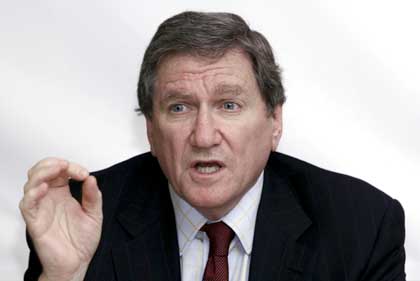
“The international community will not be able to pick up the full cost of reconstruction,” Holbrooke said.
“There will be a need for continued international assistance, but what we need to stress is that at a time of scarcity in other countries, a reconstruction effort cannot be financed completely by other countries.”
The US envoy called on the Pakistani government to redouble its efforts to help the 21 million people the UN estimates have been affected by the disaster, including 12 million needing emergency food aid.
“They have to take the lead. Pakistanis know they have to do more and how much they do remains to be seen, and what the needs are remain to be seen,” Holbrooke said.
USAID chief Rajiv Shah warned Monday that the risk of diseases such as cholera is increasing as people return to their homes.
“The first and most critical priority is to prevent the spread of water-borne illnesses,” Shah said.
“In a flood of this magnitude, even as the flood waters recede, the likelihood of water-borne illness and cholera... actually increase as people go back to their homes but do not have effective and safe sanitation environments, and water doesn't completely recede.”

“Pakistan has an obvious, major energy problem and we are sympathetic to that, but in regards to a specific project, legislation is being prepared that may apply to the project,” he said, referring to the pipeline.
“We caution the Pakistanis not to over-commit themselves until we know the legislation.”
Pakistan is plagued by chronic electricity shortages that have led to mass demonstrations.
US Senator Joseph Lieberman said last week he expects Congress to finish shortly legislation tightening US sanctions on Iran that will include provisions affecting the supply of refined petroleum products to Tehran, and add to sanctions on its financial sector.
Lieberman, an independent, is a member of a House-Senate committee of negotiators working on final details of the bill and said it could pass by July 4.
The $7.6 billion natural gas pipeline deal, signed in March, doesn't directly deal with refined petroleum products and was hailed in both Iran and Pakistan as highly beneficial.
The US has so far been muted in its criticism of the deal, balancing its need to support Pakistan, a vital but unstable ally in the global war against al-Qaeda, with its desire to isolate Iran.
But the legislation could be comprehensive enough to have major implications for Pakistani companies, Holbrooke said.
“We caution Pakistan to wait and see what the legislation is.”
This was Holbrooke's tenth trip to Pakistan since President Barack Obama appointed him special representative to the region. His visit followed a series of working groups this week that are part of the US-Pakistan strategic dialogue, which both countries say will lay the groundwork for a new relationship.
Afghanistan was on the agenda in meetings with the Pakistani leadership, Holbrooke said, including talks on a Pakistani role in talks between the Afghan Taliban and the Kabul government.
But the United States would not support Pakistan pushing the Haqqani network, one of the strongest factions of the Afghan insurgency and mostly based in Pakistan's North Waziristan, into talks with Kabul as Washington sees the group as intransigent, brutal and too tightly allied with al-Qaeda.
The United States has said any groups wishing to lay down their weapons must renounce al-Qaeda and agree to participate peacefully in the Afghan political process.
“It's just hard to see that happening,” Holbrooke said of the Haqqani network.
Regardless of what happens in Afghanistan, he said, the United States would remain engaged with Pakistan.
“Pakistan matters in and of itself. Whatever happens in Afghanistan, the US cannot turn away from Pakistan again,” he said. “We are not going to repeat the mistakes that occurred — at least not on our watch — of the last 20 years.”
WASHINGTON: Pakistanis see their country in crisis and they give their national government lower ratings than at any time in this decade. And almost no one is satisfied with national conditions, a latest survey indicated.President Asif Zardari’s popularity is at all-time low at 32 per cent while Pakistan Muslim League-N leader Nawaz Sharif has reached a new high at 79 per cent approval ratings. The role of Pakistani media is viewed favourably as almost 77 per cent of those interviewed for the survey believe that the media is having good influence on the country.Overall, 89 per cent say they think of themselves first as Pakistani, rather than as a member of their ethnic group, the survey said.Conducted by the Pew Research Centre’s Global Attitudes Project, it also finds that a long-standing concern about extremism has grown even greater over the past year, and indifference and mixed opinions about both Al Qaeda and the Taliban have given way to a strong condemnation of both groups.While views about national conditions are overwhelmingly negative, most Pakistanis are upbeat about their personal lives — 74 per cent say they are very or somewhat satisfied with their overall lives, and most are satisfied with their family lives and incomes.


He warned that if the funds required were not provided to the military it would be forced to ‘reprioritise’ its options, possibly affecting Pakistan’s cooperation in the war on terror.
The PAC was discussing the accounts of defence services for 2007-08 at a meeting chaired by Chaudhry Nisar Ali Khan.
Lt-Gen Ali told the meeting that armed forces’ personnel remained heavily engaged in operations in Malakand division and South Waziristan which required an uninterrupted supply of funds.
“During my recent meeting with US defence secretary, I raised the issue of delays in release of money under the Coalition Support Fund (CSF), telling him that in the absence of necessary support we won’t be able to maintain high level of cooperation,” he said.
After a lot of bickering some funds were finally released under the CSF, he said.
The CSF pertains to expenditures incurred on the troops’ food, clothing, transportation, communications and medical care, besides helicopter operations and repair and maintenance of equipment.
Answering questions, the defence secretary said the armed forces demanded Rs530 billion for the next financial year. However, the government agreed to provide only Rs488 billion, forcing the security establishment to dig into development funds and other reserves set aside for contingencies and emergencies.
At this, Auditor-General Tanvir Ali Agha said it wasn’t possible for the government to meet budgetary estimates proposed by every government department.
“Here come in good financial practices. You people have to readjust your priorities according to the funding available,” he said.
Chaudhry Nisar said the so-called war on terror had been imposed on the poor nation, “turning everything into a mess”.

The United States has long pressed the Pakistani military to crack down on the so-called Haqqani faction in the North Waziristan tribal region, which borders Afghanistan, but Islamabad has so far balked at doing so.
General David Petraeus, who oversees the Afghan war as head of US Central Command, told a Senate hearing that he, the top US and Nato commander in Afghanistan and the chairman of the Joint Chiefs of Staff raised Haqqani links in a recent meeting with Pakistan army chief Ashfaq Kayani.
“We have shared information with him about links of the leadership of the Haqqani network located in North Waziristan that clearly commanded and controlled the operation against Bagram air base and the attack in Kabul, among others,”Petraeus said.
Suicide bombers carrying rockets and grenades launched a brazen predawn attack on the base on May 19, killing an American contractor and wounding nine US troops.
About a dozen militants, many wearing suicide vests packed with explosives, were killed, the Pentagon said at the time.
A day earlier, a suicide bomber attacked a military convoy in Kabul, killing 12 Afghan civilians and six foreign troops.
The Pentagon has expressed confidence that Pakistan will eventually mount an offensive in North Waziristan, but said Islamabad would decide on the timing.
The Haqqani network has long been described by US forces as one of their biggest enemies in Afghanistan.
But there are strategic reasons for Pakistan's hesitancy to attack the Haqqanis.
Pakistan sees the group as a strategic asset that will give it influence in any peace settlement in Afghanistan so Islamabad will want those militants on its side.
The United States has increased pressure on Pakistan to act in North Waziristan following a botched May 1 car-bombing in New York's Time Square that US investigators have blamed on the Pakistani Taliban.
But Pentagon officials have said they understood the Pakistani military was already stretched by operations in other tribal areas.
 DAMBULLA, Sri Lanka: Pakistan captain Shahid Afridi’s stunning century was in vain as Sri Lanka claimed a 16-run win on Tuesday in the opening match of the Asia Cup.
After the Sri Lankans had made a competitive 242-9 from their 50 overs, Pakistan’s top order imploded to leave Afridi the difficult task of guiding his team home.
The allrounder fought off the effects of cramp — which forced him to limp for his runs — to make 109 off 76 balls before he was snared by offspinner Muttiah Muralitharan, who struggled to contain the inspired Afridi throughout his innings.
Lasith Malinga then cleaned up the tail to finish with figures of 5-34 off his 10 overs, with Pakistan falling just short of the victory target. It was the seamer’s maiden five-wicket haul.

Malinga gave the host the ideal start by bowling opener Sulman Butt (0) with an inswinger on the ninth delivery of the day.
Unrelenting pressure by the Sri Lankan seamers saw three more wickets go down — Shahzaib Hasan (11), Umar Amin (7) and Shoaib Malik (8) — to leave Pakistan on 32-4.
Afridi came to the crease and started the counterattack with two consecutive sixes off seam bowler Farveez Maharoof. Afridi and Umar Akmal (30) shared a 73-run partnership to raise the team’s hopes.
Afridi was particularly severe on Muralitharan, hitting him for five of his seven sixes, while he also hit eight fours in a sublime knock.
Muralitharan, the world’s most prolific wicket-taker, went for 71 runs in his 10 overs but did take the prized scalp of Afridi.
Afridi fell to the ground after playing some of his shots and the team’s medical staff had to attend to him at least three times on the field. Strangely, though, a runner was not used and it was not immediately clear if a request was denied by the umpires or the opposing captain.
After the departure of Afridi, Malinga wrapped up the innings by bowling Mohammad Aamer (5) and Mohammad Asif (0), and also had Shoaib Akhtar (1) caught.
Earlier, Akhtar celebrated his return to international cricket with 3-41 to help restrict Sri Lanka, who had good knocks from Angelo Mathews (55 not out) and former captain Mahela Jayawardene (54).
Sri Lanka captain Kumar Sangakkara’s decision to bat first in the day-night encounter at Rangiri Dambulla Stadium paid off when his openers Tillakaratne Dilshan (18) and Upul Tharanga (11) got off to a promising start.
Akhtar, playing his first match for Pakistan in 13 months after injuries, then intervened to reduce the Sri Lankans to 36-2.
Sangakkara (42 from 63 balls) and Jayawardene salvaged the innings with a sensible 83-run partnership for the third wicket, off 103 balls.
Jayawardene was given out lbw but television replays showed the ball hit the bat before hitting his pads. His 53rd limited-overs half-century included three boundaries.
Jayawardene’s dismissal made it 150-4 and triggered a mini-collapse, Sri Lanka losing four wickets for 18 runs.
Mathews joined tailender Nuwan Kulasekara (14) and repaired the innings with a 43-run partnership. He faced 61 balls and hit four boundaries.
Sri Lanka is looking for a third consecutive Asia Cup title, having won the previous two editions — in 2004 and 2008. Pakistan was last crowned Asian champion a decade ago.
India and Bangladesh are the other teams participating in the tournament. -AP
Scores: Sri Lanka 242-9 in 50 overs (M. Jayawardene 54, A. Mathews 55 not out; Shoaib Akhtar 3-41) v Pakistan 226 all out in 47 overs (S. Afridi 109; L. Malinga 5-34)
Pakistan: Shahid Afridi (capt), Salman Butt, Shahzaib Hasan, Umar Akmal, Shoaib Malik, Umar Amin, Kamran Akmal, Abdul Razzaq, Mohammad Asif, Mohammad Aamer, Shoaib Akhtar.
Sri Lanka: Kumar Sangakkara (capt), Mahela Jayawardene, Tillakaratne Dilshan, Upul Tharanga, Thilan Samaraweera, Angelo Mathews, Farveez Maharoof, Chamara Kapugedara, Nuwan Kulasekara, Lasith Malinga, Muttiah Muralitharan.
Umpires: Billy Bowden (NZL) and Billy Doctrove (WIS)
TV umpire: Sanjay Hazare (IND)
Match referee: Andy Pycroft (ZIM)


“There are some formalities and as soon as we are given clearance from the concerned country our planes would take off to bring back the students home,” he said.
More than 269 Pakistanis, mostly medical students, were stranded in Kyrgyzstan where ethnic riots broke out between ethnic Kyrgyz and minority Uzbeks, leaving 113 dead and injuring hundreds others.
Qureshi said the foreign ministry was trying its maximum to bring back the students to Pakistan.
All Pakistanis have been asked to gather at the airport in Osh. The list of stranded Pakistanis had also been handed over to Kyrgyz authorities and the Kyrgyz government was providing full support in this regard.
Three C-130 planes will take off any time on Monday to bring back Pakistanis trapped in Kyrgyzstan, government sources told DawnNews earlier.
Foreign Minister Qureshi also denied reports suggesting that 10 Pakistani students had been taken hostage during ethnic clashes in Kyrgyzstan. He further said that some 30 to 40 students had reached to safer places in Osh.
Foreign Office spokesman Abdul Basit said the FO was in constant contact with Kyrgyz officials.
“The Pakistani embassy in Bishkek is trying to gather all nationals toward the airport in Osh,” he added.
Two Pakistani students were reportedly killed and at least 10 others were said to be taken hostage during the violence.
Meanwhile, Kyrgyzstan's Ambassador to Pakistan on Monday said only one Pakistani was killed in clashes.
"According to our information, 200 Pakistani students are currently trapped in Kyrgyzstan," the ambassador said.
Ubaidullah Ansari, a student of medical science at the Osh State University, who has returned to Jacobabad, told Dawn on Sunday that more than 500 Pakistanis were stranded in the Central Asian state.
He said a female student of final year at a medical university and Ali Raza, a fourth-year student of engineering, were killed and more than a dozen others taken hostage in the south of Kyrgyzstan.
Earlier on Sunday, Foreign Minister Qureshi said the government was in touch with Kyrgyz officials to gain access to Pakistanis and ensure their evacuation.
“We have conveyed our concern to the Kyrgyz government and are trying to contact the students in order to get them safely evacuated.”
Talking to PTV, Mr Qureshi said “our first priority is to ensure the safety of our brethren stranded there”.
Mr Ansari said he and his friends had gone for a picnic to Uzgin, 30km from Osh, on June 8, as summer vacations had begun at their university on June 1.
When they were returning to Osh on Thursday, they saw many buildings, shops and vehicles on fire and army personnel patrolling streets.
They contacted their friends by phone and were advised not to enter the city.
Mr Ansari said he and 14 other students hired taxis to reach Bishkek and took a flight of the Uzbek Airlines for Lahore.
In reply to a question, he said the students had been instructed to carry their passports whenever they went out and their visas were valid till October.
Ali Raza, the Pakistani student who lost his life, hailed from a village in Toba Tek Singh district.
Abdul Qayum Jatt, his father, told reporters that Ali Raza was a final-year student of an engineering university in Osh city.
Ali Raza was at his home when a mob belonging to an ethnic group shot him. Local people and Pakistanis tried to take him to a hospital, but he died on the way.
Mr Raza’s parents live in Rehmat Colony, near Shorkot cantonment, where they own a cotton ginning factory.
His father said he did not know when the body would arrive.
Fida Hussain Jalalani of Khairpur, a fourth-year student at the Osh State University, urged the government to save the lives of Pakistani students.
Agencies add:
The foreign minister said that around 1,200 to 1,500 Pakistanis, mostly students, lived in Kyrgyzstan.
Many of them had returned to Pakistan for summer vacations, but some had stayed back to take examinations, he said.
Mr Qureshi said the situation in the Central Asian state was worrying and the Kyrgyz government appeared helpless.
A Foreign Office spokesman said: “The ambassador of Pakistan in Bishkek is in constant touch with Kyrgyz authorities to ensure the safety and security of Pakistani nationals in and around the city of Osh.
“The embassy of Pakistan in Bishkek is maintaining close touch with Pakistani students in Osh. The ministry of foreign affairs will also take up the matter with the Kyrgyz embassy in Islamabad.”
Members of the Shanghai Cooperation Organisation had expressed concern over the situation and efforts were being made for holding a referendum in the country, which would be followed by elections, the foreign minister added.
Trapped Indians:
According to reports, over 100 Indians, mostly students, were also trapped in Osh.
The Indian mission was in close contact with the trapped individuals as well as with the Kyrgyz foreign ministry and other concerned authorities to ensure their safety.
Russian troops:
Russia sent hundreds of paratroopers to Kyrgyzstan on Sunday to protect its military facilities, Interfax news agency reported, as ethnic clashes spread in the Central Asian state.
The death toll from several days of fighting has risen to 113.
About Me


